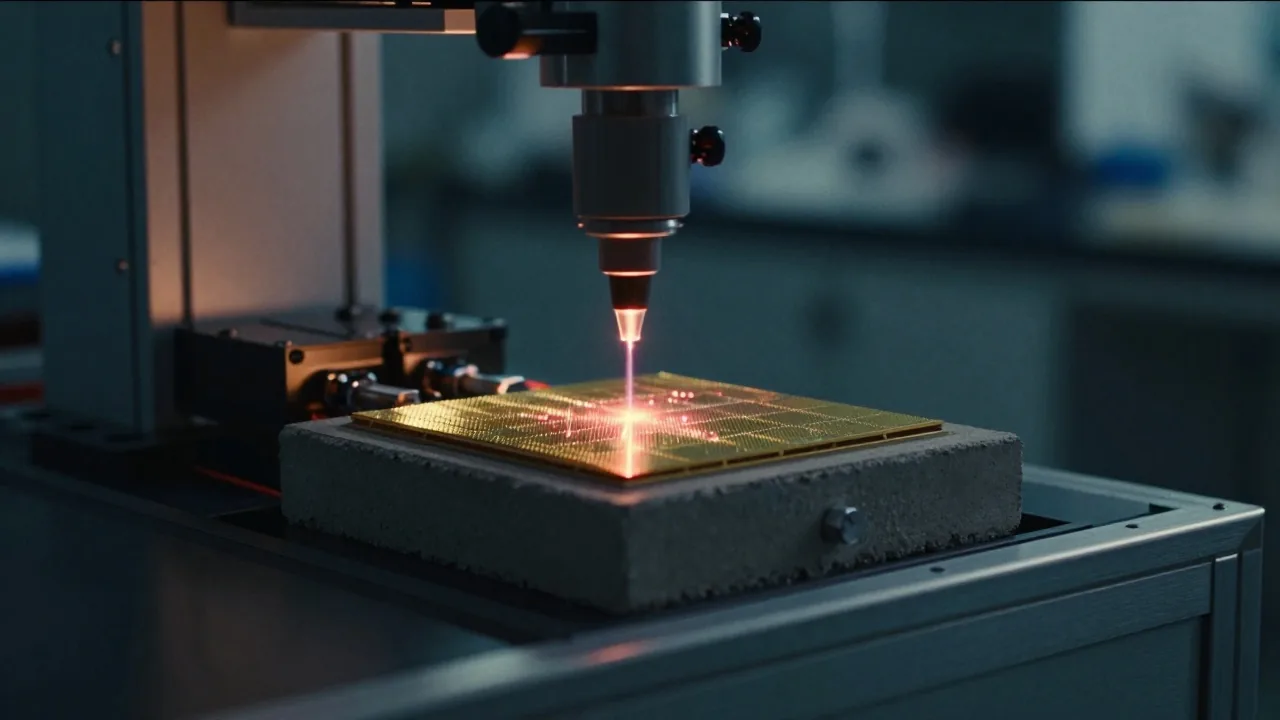
Surface-enhanced Raman scattering, SERS, is the technique that makes Raman spectra of trace molecules visible by parking those molecules close to a roughened or nanostructured noble-metal surface. The local field enhancement at the metal lifts Raman signal by factors typically quoted between 10^6 and 10^11, depending on substrate and analyte. In single-molecule SERS demonstrations, the enhancement is extreme enough to detect one adsorbed molecule at a time.
That number is the reason SERS keeps showing up in process-analytics conversations. Conventional Raman struggles below roughly 0.1 % concentration in many real matrices. SERS, in principle, takes that floor down by orders of magnitude. If the problem is detecting a low-concentration impurity, contaminant, or biomarker in a process stream, the marketing for SERS is genuinely seductive.
In practice, SERS as an inline process technique is rare, and the reasons are practical rather than theoretical. This explainer lays out what SERS does, what changes when you try to run it inline, and the small set of process-analytics problems where it is the right tool.
What SERS actually is
When a molecule sits within a few nanometres of a noble-metal nanostructure - gold, silver, occasionally copper - and is illuminated at a wavelength near the metal’s plasmon resonance, two effects amplify its Raman scattering. The dominant effect is electromagnetic: the local optical field at the metal surface is much higher than the incident field, and Raman scattering scales roughly with the fourth power of that field. A smaller chemical effect, a charge-transfer interaction between molecule and metal, contributes another order of magnitude in some cases.
The enhancement is intensely local. It falls off within nanometres of the metal surface and is concentrated at “hot spots” - gaps and crevices where the field is locally enormous. That locality is the central design constraint: SERS only enhances molecules that have made it onto the substrate. Anything still in bulk solution scatters at ordinary Raman cross-sections and is invisible against the enhanced signal.
Why quantitative SERS is hard
A standard Raman measurement obeys Beer-style proportionality reasonably well: signal scales with concentration, geometry is fixed, and a calibration done today still applies tomorrow. SERS does not behave this way.
Hot-spot density varies between substrates and even between regions of the same substrate. Adsorption of the analyte onto the metal is a competitive process - solvents, salts, surfactants, and other dissolved species all fight for the same surface area. Spectra change with adsorption geometry, not just concentration. Substrates age: silver oxidises, gold accumulates organic fouling, plasmonic features collapse under strong illumination.
The peer-reviewed literature on quantitative SERS reads like a long catalogue of mitigations: internal standards co-deposited with the analyte, ratiometric measurements against a reporter molecule, microfluidic cells that present a fresh substrate per measurement, and chemometric models trained on substrate-specific calibration sets. These mitigations work, but they share a common cost: the measurement is no longer a passive observation of a process stream. It is a small assay, with consumables and disciplined sample handling, attached to the line.
Where SERS fits in process analytics
Once that cost is acknowledged, SERS earns its place in a narrow set of problems.
Trace contamination at sub-ppm levels. Drinking-water utilities and food-processing lines occasionally need to detect pesticides, mycotoxins, melamine-style adulterants, or pharmaceutical residues at concentrations a normal inline Raman analyzer cannot see. A SERS cell with a renewable substrate, fed from a slipstream, can give a usable answer in minutes. The measurement is atline rather than truly inline, but it is much faster than sending a sample to an external laboratory.
Reaction intermediates that adsorb strongly to noble metals. Some catalytic chemistries - particularly those involving thiols, amines, and aromatic heterocycles - give SERS spectra that are not just enhanced but mechanistically informative, because the analyte’s binding to the metal mirrors its binding to the catalyst. This is closer to a research instrument than a production analyzer, but it has a place in process development.
Microfluidic SERS cassettes for biopharmaceutical impurity tracking. Several research groups and a small number of vendors have demonstrated cassette-format SERS cells for residual-host-cell-protein or low-level impurity monitoring downstream of a bioreactor. The cassette is consumable; the optics are reusable. This pattern aligns well with the disposable-flow-path culture of single-use bioprocessing.
In all three cases the signal flow is the same: a slipstream feeds a flow cell containing fresh substrate; the Raman engine reads the cell at a defined cycle time; the substrate is renewed, or the cassette stepped forward, before the next measurement.
Where SERS does not fit
Most process-analytics problems are better served by ordinary Raman or another inline technique.
Bulk reaction monitoring at percent-level concentrations does not need enhancement. A standard 785 nm or 1064 nm Raman probe will return a clean spectrum without consumables. Adding SERS substrates only adds failure modes.
Solids and powders cannot be SERS-active in any practical inline configuration: the analyte never makes thermodynamic contact with a metal surface in a way that matters. NIR and standard Raman are the right techniques for blend uniformity, granulation endpoints, and tablet identity.
Strong-fluorescence matrices - lignin streams, certain dye chemistries, biological broths heavy in cofactors - are sometimes proposed as a SERS use case, on the grounds that the metal surface quenches fluorescence. The quenching is real, but so is fluorescence-burst behaviour at hot spots, and time-gated Raman or longer-wavelength excitation are usually a cleaner answer.
How to evaluate a SERS proposal
The questions that decide whether SERS is appropriate for an inline or near-line measurement are essentially commercial:
- What is the analyte concentration, and is it actually below the limit of detection of a conventional 785 nm or 1064 nm Raman analyzer with a few seconds of integration?
- Will the analyte adsorb onto the candidate substrate from the real process matrix, in the presence of competing species?
- What is the substrate consumable cost per measurement, and how often is the cell or cassette renewed in a typical week of operation?
- Has the vendor demonstrated stability against fouling, drift, and substrate-to-substrate variability in your matrix, not just in clean buffer?
- Is the measurement architecture truly online, or is it an automated atline assay running continuously?
If the conventional Raman answer to question 1 is “yes, you need enhancement” and questions 2 through 5 have credible answers, SERS is worth piloting. If question 1 has a “no”, the project is almost always better served by improving the conventional Raman geometry - better probe optics, longer integration, internal-standard chemometrics - than by introducing a substrate-dependent technique.
A short verdict
SERS is an excellent laboratory technique and a difficult production technique. It is the right answer for a small, well-defined class of trace-level problems that are honestly out of reach for conventional Raman. It is the wrong answer for most other process-analytics work, and the failure mode of using it where it does not belong - drift, fouling, irreproducible quantification - is harder to diagnose than simply not having a measurement at all.
When SERS comes up as a candidate, the question to put back to the proposer is almost never “does the enhancement work?”. It is “what does the substrate look like after a month, and who pays for the next one?”.