
How ICH Q9(R1) Applies to Chemometric Models in Pharmaceutical PAT
Quality risk management under ICH Q9(R1) reshapes how pharmaceutical manufacturers classify, validate, and maintain chemometric models embedded in process analytical technology.
Quality risk management under ICH Q9(R1) reshapes how pharmaceutical manufacturers classify, validate, and maintain chemometric models embedded in process analytical technology.

Each update to an approved chemometric procedure in the EU is a regulatory event. Commission Regulation No 1234/2008 and ICH Q14 determine which variation type applies and whether prior approval is needed.

Three years after ICH Q13 came into force, 17 continuous-manufacturing drug approvals sit on the FDA's ledger and 72 CM technologies have joined the Emerging Technology Program - but adoption remains narrow.

EMA's Q&A on nitrosamines now runs across a main document and three appendices, with Appendix 1 refreshed on 24 June 2026. The methodology stack pushes analytical work firmly into LC-MS/MS at sub-ppb sensitivity.

MUR 22 was signed in December 2024 and public comments closed in March 2025. Sixteen months on, EPA has not finalized it. Labs face draft PFAS and PCB methods not yet required for NPDES monitoring.

Inline sensors keep SCR systems fed and flag misfilling, but the ppm-level contamination limits that ISO 22241 actually specifies still land in a laboratory. Here is where the two meet, and where they do not.

Composite-wood and resin producers face three overlapping formaldehyde regimes: CARB ATCM 93120 in North America, EN 717-1 in Europe, and the CLP Carc 1B classification. What each measures and where they meet.

The EU formaldehyde emissions restriction under REACH Annex XVII Entry 77 applies from 6 August 2026. Phenol-formaldehyde resin producers need chamber-method emission data and batch documentation in place now.

At its Rio de Janeiro Assembly on 2-3 June 2026, ICH brought E6(R3) Annex 2 to Step 4, extending GCP to decentralised and registry-based trials. Q1 and Q3E remain in draft review.

FDA, EMA, and PMDA all build on ICH Q2(R2) and Q14, but their expectations for routine chemometric model upkeep, post-approval changes, and reference-method failures diverge in ways that shape submission strategy.

A partial least squares model rarely survives the move to a second instrument unchanged. A working protocol covers transfer set design, the standardisation method, and the acceptance criteria.

Univariate SPC watches one number. A spectroscopic analyser produces a thousand. Multivariate SPC condenses them into two statistics that have been the standard since the early 1990s.

Six recent peer-reviewed PAT papers worth a read: lean chemometrics for spectroscopic models, simpler bioprocess Raman regressions, at-line terahertz for crystallinity, and PAT-with-machine-learning past the bioreactor.

Two ECHA actions in early 2026 redraw the regulatory map for EU analytical-chemistry suppliers: n-hexane enters the SVHC Candidate List, and the universal PFAS restriction enters its final public consultation.

A calibration set defines what a chemometric model can predict, and where it will fail. Five planning decisions made up front determine whether validation later passes or unravels.

Three recent papers shift the calibration-transfer conversation: a low-rank fine-tuning method for deep Raman models, a vendor-to-vendor PDS/SST study, and single-compound shortcuts that sidestep paired transfer sets.

EMA's March 2026 Q&A on 3D-printed solid oral doses accepts inline NIR and Raman spectroscopy for unit-level rejection, anchoring personalised micro-batches in the QbD and RTRT framework.

QbD is the broader regulatory philosophy that PAT serves. A primer on the ICH and FDA documents that built it, the vocabulary it introduced, and how process analytics fits inside it.

March-May 2026 in ACS Analytical Chemistry: three threads for process analytics - close-focus Raman probes for turbid streams, deep-learning chemometrics, and open-source spectroscopy tooling.

Twenty years of guidance documents - 2004 FDA PAT guidance, ICH Q8 through Q14, ASTM E2363 - turned a fragmented vocabulary into a working framework. A reading guide.

USP chapters 858 (Raman Spectroscopy) and informational 1858 replaced chapter 1120 on 1 August 2020. Almost six years on, handheld identity testing is the workhorse application; compendial method adoption is uneven.

ICH Q14 reached Step 4 in November 2023. Thirty months on, the EU, FDA, Swissmedic and China NMPA have it on the books, but the ISPE readiness survey shows enhanced-approach adoption sitting at 19%.
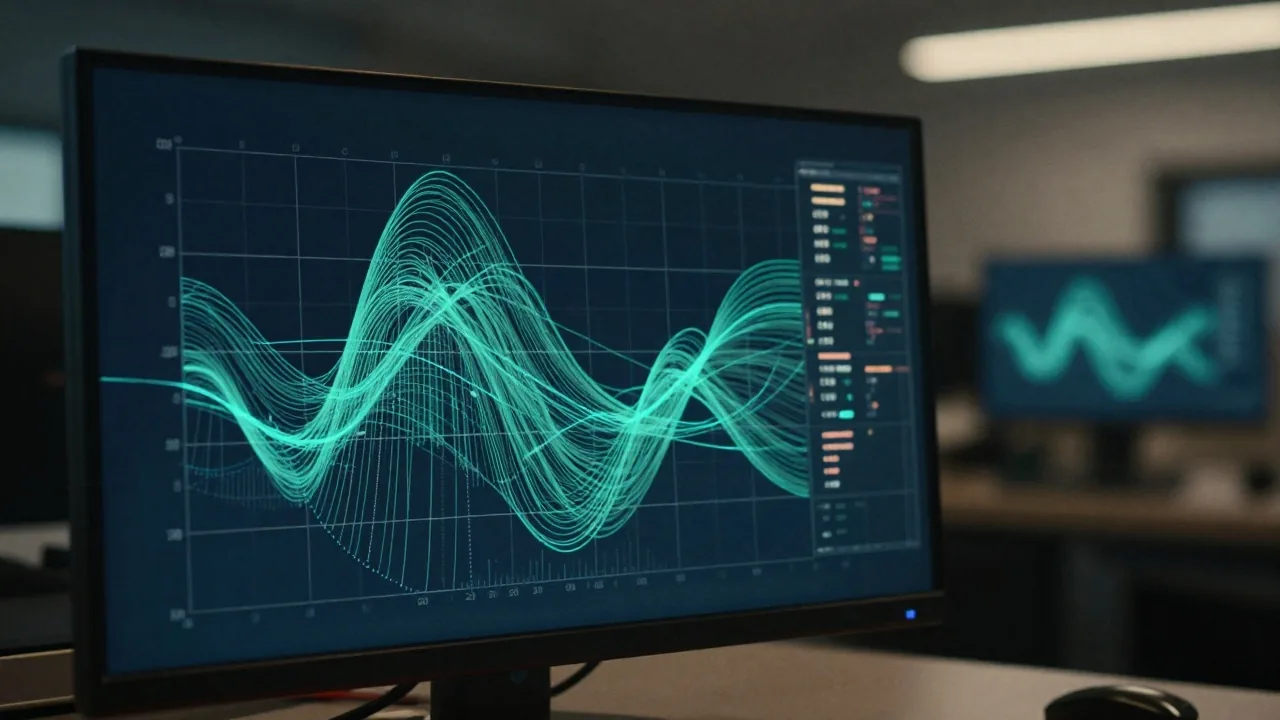
Spectra are not answers. The bridge between a 1,000-channel spectrum and a number you can act on is chemometrics - a small toolbox of multivariate methods, used the same way for forty years.

Both methods take a 1,000-channel spectrum and compress it into a handful of latent variables. They are not interchangeable. PCA describes; PLS predicts. The decision is older than most of the software.
ICH Q14 sets the framework. ASTM E1655 sets the practice. The intersection - what an inspector actually wants to see in a chemometric validation file - is a short, specific list.